News Afrika
News Afrika
HomePoliticsEconomyMediaBusinessTechnologyHealth

Privacy PolicyTerms of ServiceAbout UsContact UsEditorial PolicyCorrections PolicyOwnership & FundingOur TeamCookie PolicySitemap

© 2026 News Afrika • Independent African Journalism • All Rights Reserved

    HomeEconomyBillions Sent Home by SA Migrants: Economic Lifeline for Neighbours or Symptom of Local Brain Drain?
    Economy

    Billions Sent Home by SA Migrants: Economic Lifeline for Neighbours or Symptom of Local Brain Drain?

    Remittances flowing from South Africa are propping up households across the region — but the money trail also reveals deeper strains inside Africa’s most industrialised economy.

    By:Nathaniel A. Bapela
    February 18, 2026
    3 min read
    Migrant worker sending money home from South Africa
    Money transfer services play a vital role in supporting families across Southern Africa. | Photo: Photograph via X
    • •South Africa remains one of the largest sources of remittances within the Southern African region.
    • •For neighbouring economies, money sent home from migrant workers forms a critical share of household income and GDP.
    • •Rising unemployment and political tension in South Africa have intensified debate over migration and labour market pressures.

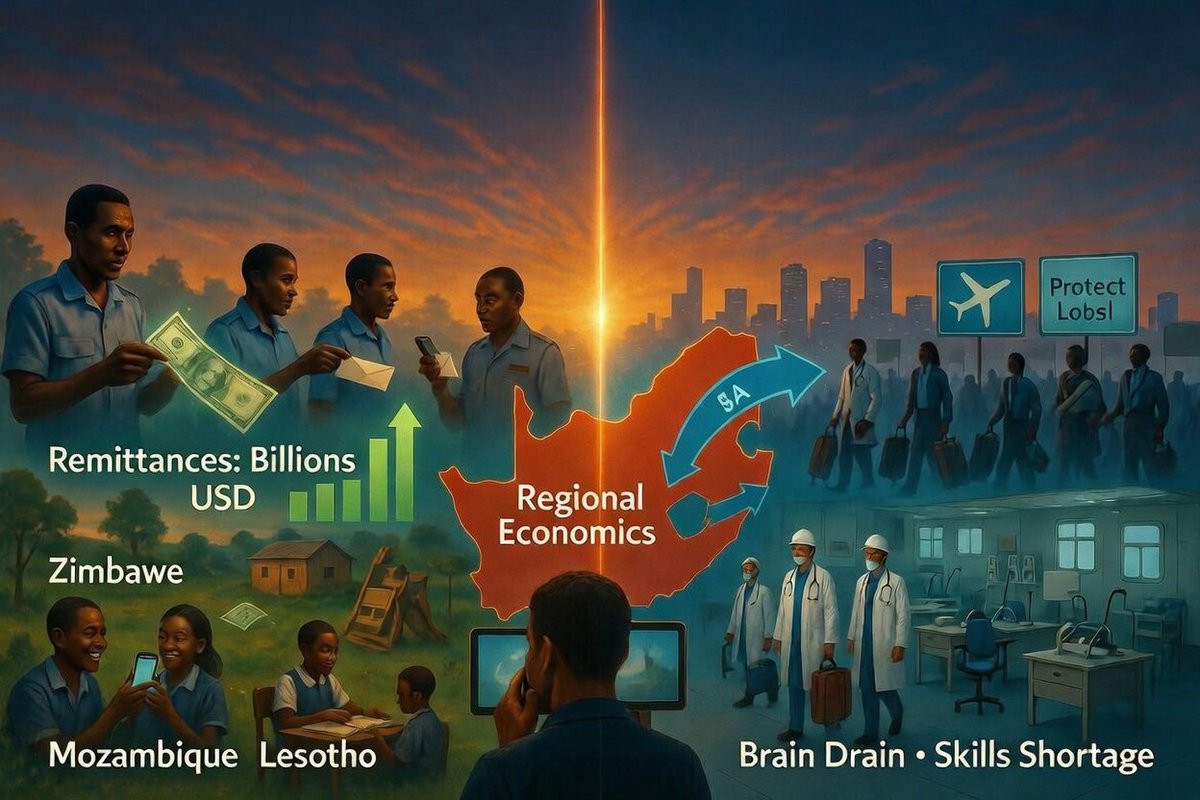
    Every month, billions of rand leave South Africa quietly — wired across borders to families in Zimbabwe, Mozambique, Lesotho and beyond. For many households, that money means school fees paid and food on the table. For South Africa, it raises harder questions about labour markets, migration policy and the rising temperature of xenophobic politics.

    At a small money transfer outlet in downtown Johannesburg, the queue forms early. Construction workers, domestic workers and informal traders wait patiently to send part of their earnings north. For many, this monthly ritual is non-negotiable.

    "If I don’t send something home, my family doesn’t eat," says Tawanda, a Zimbabwean mechanic who has worked in South Africa for eight years. "This is not extra money. It’s survival."

    South Africa has long been the economic anchor of the Southern African region. Its mines, farms, factories and service industries draw workers from neighbouring states where formal employment opportunities are scarce.

    A Regional Safety Net

    According to regional financial estimates and central bank reporting across the Southern African Development Community, remittances from South Africa form a significant portion of household income in countries such as Zimbabwe, Lesotho and Mozambique.

    Economists argue that these transfers do more than meet daily expenses. They stabilise exchange rates, strengthen foreign currency reserves and support small business formation in rural communities.

    Remittances are often more stable than foreign direct investment or aid. They go directly into communities and immediately circulate in the local economy.

    Pressure at Home

    Yet the outward flow of money sits uncomfortably alongside South Africa’s own economic struggles. With unemployment hovering above 30 percent in recent quarters, frustration among local jobseekers has intensified.

    Labour economists caution that the picture is more complex. Many migrant workers occupy roles in sectors facing labour shortages or difficult working conditions.

    Brain Drain or Labour Circulation?

    South Africa itself faces an outward brain drain, with skilled professionals emigrating to Europe, Australia and North America.

    Some analysts describe this as labour circulation rather than a simple drain. Skills and earnings move across borders, linking economies historically integrated through mining and industrial networks.

    The Xenophobia Risk

    Economic downturns often sharpen social fault lines. Episodes of xenophobic violence over the past decade have targeted foreign-owned shops and migrant communities.

    What Happens Next?

    As regional integration efforts advance under the African Continental Free Trade Area, migration policy is likely to face renewed scrutiny.

    For families across Southern Africa, the calculus remains simple: the next transfer keeps the lights on.

    Sources

    • Southern African Development Community Migration Reports
    • World Bank Migration and Remittances Data

    Tags

    remittances
    migration
    brain drain
    xenophobia
    regional economy
    southern africa

    Related Stories

    South African Electricity Minister Kgosientsho Ramokgopa speaking during a public address.
    ENERGY
    •2 MIN READ

    Ramokgopa Acknowledges Electricity Costs Are 'Expensive'

    Electricity and Energy Minister Kgosientsho Ramokgopa has acknowledged that electricity in South Africa has become increasingly expensive, responding to growing public frustration over rising tariffs and continued concerns about power supply stability.

    March 14, 2026
    Oil refinery and fuel infrastructure representing global fuel markets.
    ENERGY
    •3 MIN READ

    Fuel Price Outlook Turns Catastrophic as Brent Surges Past $100 and Rand Weakens

    South Africa could face a sharp increase in fuel prices as global oil markets surge amid escalating tensions in the Middle East. With Brent crude rising above $100 per barrel and the rand weakening against the US dollar, early estimates suggest petrol prices could climb by more than R5 per litre and diesel by over R8 if current trends continue.

    March 14, 2026
    Market paper graph with calculator and specs on the desk
    INVESTMENT
    •4 MIN READ

    Africa’s $3.4 Trillion Opportunity: Why Global Investors Are Turning to the Continent

    March 10, 2026
    Aerial view of open-pit copper mine with trucks and workers
    NATURAL RESOURCES
    •4 MIN READ

    The New Scramble for African Minerals: Who Really Controls the Resources?

    March 10, 2026