News Afrika
News Afrika
HomePoliticsEconomyMediaBusinessTechnologyHealth

Privacy PolicyTerms of ServiceAbout UsContact UsEditorial PolicyCorrections PolicyOwnership & FundingOur TeamCookie PolicySitemap

© 2026 News Afrika • Independent African Journalism • All Rights Reserved

    HomeWorldGuterres Urges UN Security Council Reform: "This Is 2026 – Not 1946"
    World

    Guterres Urges UN Security Council Reform: "This Is 2026 – Not 1946"

    UN chief says the world body’s most powerful organ no longer reflects modern geopolitical realities, calling reform a matter of credibility.

    By:Elize Smit
    February 17, 2026
    3 min read
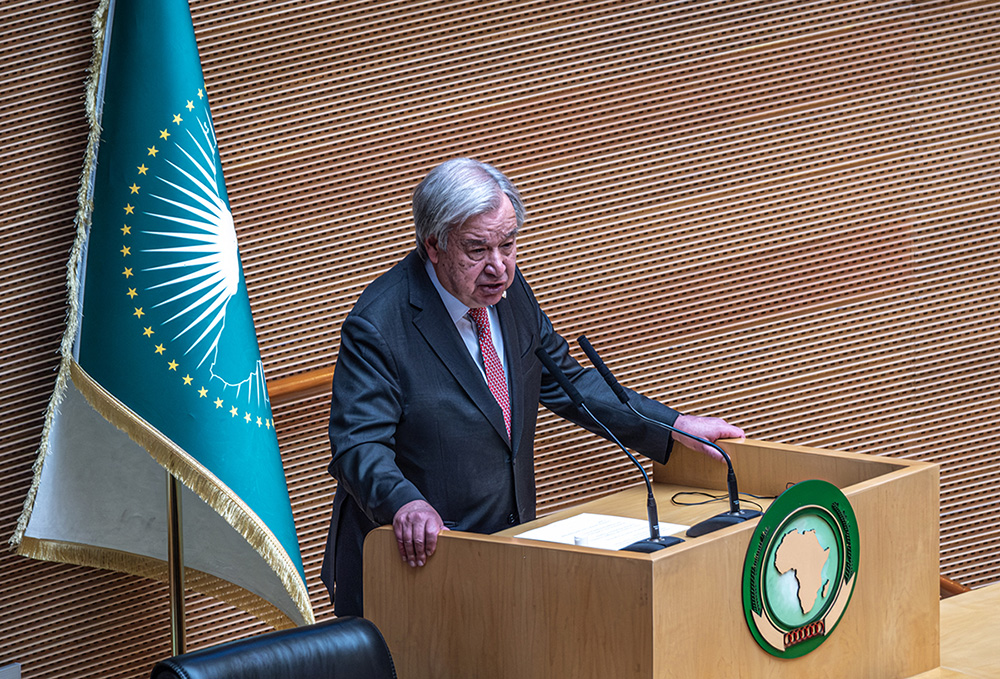
    UN Secretary-General António Guterres addressing delegates at the United Nations.
    Secretary-General António Guterres addresses member states amid renewed calls for Security Council reform. | Photo: © New Vision / AFP
    • •Guterres says the Security Council structure no longer reflects today’s geopolitical balance.
    • •Calls grow for expanded representation for Africa, Latin America, and emerging economies.
    • •Debate over veto power remains the most contentious obstacle to reform.

    United Nations Secretary-General António Guterres has renewed his push for reform of the UN Security Council, arguing that the body’s structure reflects a post-World War II order that no longer matches global political and economic realities.

    Speaking before member states at UN headquarters in New York, Secretary-General António Guterres argued that the Security Council’s composition and decision-making powers are rooted in 1946 — a vastly different political era shaped by the aftermath of World War II.

    "This is 2026 – not 1946," Guterres told delegates, stressing that legitimacy in global governance depends on institutions reflecting current geopolitical and economic realities.

    The Security Council currently consists of 15 members, including five permanent powers — the United States, the United Kingdom, France, Russia, and China — each wielding veto authority. While that structure was designed to prevent another global conflict among major powers, critics argue it now hampers effective action on modern crises.

    A Question of Representation

    Calls for reform have intensified in recent years, particularly from African, Latin American, and Asian nations that say the council fails to represent the demographic and economic weight of the Global South. Africa, for instance, has no permanent seat despite comprising 54 member states.

    Several reform proposals include expanding both permanent and non-permanent membership, limiting or suspending veto use in cases involving mass atrocities, and introducing longer-term elected seats for emerging powers.

    Veto Power: The Central Obstacle

    At the heart of the debate lies the veto. Any meaningful amendment to the UN Charter would require approval from two-thirds of the General Assembly and ratification by all five permanent members — including those whose influence could be diluted by reform.

    The veto has repeatedly stalled resolutions on conflicts in Ukraine, Gaza, and Syria, exposing deep divisions among major powers and raising questions about the council’s ability to act decisively during humanitarian emergencies.

    Credibility and the Future of Multilateralism

    Guterres framed reform not simply as a procedural adjustment but as a test of the UN’s relevance. He warned that public trust in multilateral institutions erodes when decision-making appears disconnected from contemporary realities.

    Analysts note that without structural change, parallel alliances and regional blocs may increasingly bypass the Security Council, further fragmenting global governance.

    For now, reform discussions remain incremental and politically sensitive. Yet Guterres’ message was clear: a system designed for the mid-20th century cannot effectively manage the complexities of the 21st.

    Whether member states can bridge strategic rivalries and agree on structural change will determine not only the future of the Security Council but also the credibility of the United Nations itself.

    Sources

    • United Nations Security Council Overview

    Tags

    UN Security Council
    António Guterres
    Global Governance
    International Relations
    Veto Power

    Related Stories

    President Donald J. Trump Departs the South Lawn | by whitehouse45
    INTERNATIONAL RELATIONS
    •5 MIN READ

    How Donald Trump’s Foreign Policy Could Reshape US–Africa Relations in 2026

    The direction of United States foreign policy has long carried major implications for Africa’s economic partnerships, security cooperation, and diplomatic alignment. In 2026, renewed attention on Washington’s international priorities has sparked debate among analysts about how the foreign policy approach associated with Donald Trump could influence relations between the United States and African nations.

    March 9, 2026
    Bulk carrier vessels navigating open waters, symbolizing global maritime trade routes under pressure.
    GLOBAL ECONOMY
    •3 MIN READ

    Global Shipping Disruptions Return: Why 2026 Could Test Supply Chains More Severely Than 2022

    Early indicators suggest that global supply chains are once again entering a stress phase. Freight benchmarks are edging upward, insurers are repricing maritime risk, and vessels are rerouting around sensitive corridors. While the system is not yet in crisis, the structural buffers built after 2022 are now being tested under a new combination of geopolitical and climate pressures.

    March 3, 2026
    Several South African Airways aircraft parked on the sunny airport tarmac with clear blue skies and a terminal building visible.
    AVIATION
    •2 MIN READ

    Johannesburg to Dubai: Travel Uncertainty Grows Amid Escalation

    Flights between Johannesburg and Dubai have long symbolised opportunity — linking Southern Africa to global markets, tourism hubs and investment corridors. But as regional tensions intensify, uncertainty is beginning to ripple through air travel, raising fresh questions about route stability, insurance costs and passenger confidence.

    March 2, 2026
    Silhouette of oil pumpjack and wind turbines against orange sunset sky with sun visible.
    ENERGY
    •2 MIN READ

    Oil at the Brink: How Middle East Tensions Threaten to Trigger a Worldwide Energy Shock

    Oil markets are once again on edge as rising Middle East tensions threaten key production hubs and shipping corridors. With traders pricing in supply disruption risks, even limited attacks could trigger a global energy shock that reverberates from fuel pumps to food prices.

    March 2, 2026