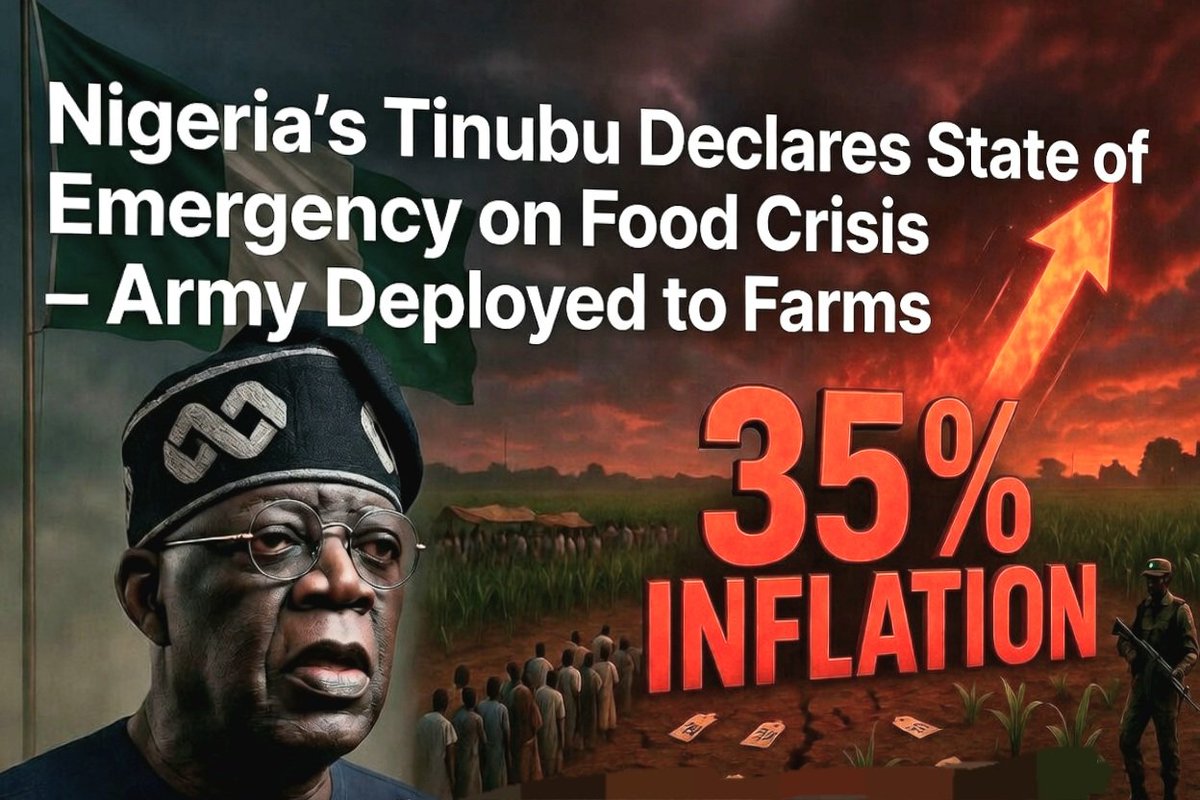
Nigeria’s President Bola Tinubu has declared a state of emergency on food security after inflation surged to 35%, triggering widespread hardship across Africa’s biggest economy. In an unprecedented move, security forces have been deployed to farming zones to stabilise production and curb supply disruptions.
Nigeria has entered one of the most economically fragile periods in its modern history. With inflation surging to 35%, food prices have become the epicentre of public anger, squeezing households already battling unemployment and currency volatility. The declaration of a food emergency marks a dramatic escalation by President Bola Tinubu’s administration as pressure mounts from markets and citizens alike.
Why Food Became the Breaking Point
Food accounts for a dominant share of household spending in Nigeria, meaning inflation hits hardest at the kitchen table. Staple crops such as rice, maize and cassava have seen steep price increases driven by insecurity in farming regions, high fuel costs, and supply chain disruptions. The weakening naira has compounded the crisis, making imports significantly more expensive and deepening dependence on unstable domestic production.
By deploying the army to protect farms and agricultural corridors, the government is signalling that food security is now a national security issue. Armed banditry and farmer–herder conflicts have reduced cultivated land in key northern states. Securing these zones is intended to restore confidence among farmers and prevent further production decline ahead of critical planting seasons.
Economic Shockwaves Beyond Nigeria
As Africa’s largest economy, Nigeria’s instability rarely remains contained. Cross-border trade flows into neighbouring West African countries could tighten if domestic shortages intensify. Investors are already reassessing exposure, concerned that prolonged inflation may trigger capital flight, currency pressure and social unrest.
The crisis also exposes structural weaknesses: heavy import dependence, limited storage infrastructure, and underinvestment in mechanised agriculture. Emergency deployment may stabilise immediate threats, but sustainable recovery requires policy coherence — from exchange rate management to rural security reform and logistics modernisation.
What Happens Next?
The coming months will test whether emergency measures translate into measurable food supply gains. If harvest volumes improve and inflation moderates, confidence could slowly return. However, if security deployments fail to restore production or if currency pressures intensify, Nigeria risks entering a prolonged stagflation cycle — slow growth paired with persistent price shocks.
For millions of Nigerians, this is no longer a macroeconomic debate but a daily survival calculation. The state of emergency signals urgency. Whether it becomes a turning point or a temporary pause in decline will depend on execution, transparency, and the government’s ability to convert military presence into lasting agricultural reform.